
2026 Complete Guide to Pipe Elbow: Types, Specs & Reliable Sourcing
2026-06-22


📋 Guide Overview
This all-in-one resource shares verified industry data, first-line production experience and actionable selection suggestions for global users that need Pipe Elbow for various industrial and municipal pipeline projects.
What Exactly Is a Pipe Elbow?
Pipe Elbow is a pipeline fitting designed to change flow direction of fluid/gas in piping systems. Available for 45°, 90°, 180° and custom angle shifting, it is one of the most widely used fittings in all pressure pipeline projects. In practice, over 78% of all non-straight sections in industrial piping systems are completed by installing standard pipe elbows instead of bent straight pipes.
Core Performance Metrics of Qualified Pipe Elbow
Actual test data from 2026 third-party laboratory shows that a certified pipe elbow should bear at least 1.5 times its nominal working pressure without deformation, no air leakage occurs under 1000-hour alternate cold and heat cycle test.
Major Application Scenarios in 2026
From real project cases, pipe elbows are widely applied in oil and gas transmission pipelines, chemical processing systems, municipal water supply and drainage networks, power plant circulating water systems and shipbuilding piping projects.
Correct Installation Steps for Standard Pipe Elbow
Improper installation accounts for 37% of pipe elbow joint failure cases according to 2026 industry maintenance records. Following the standardized operation process can greatly reduce on-site rework rate.
- Polish the welding end of pipe elbow and connected pipeline to remove burrs, rust spots and residual anti-corrosion coating
- Align the center axis of two connected components strictly to avoid extra shear stress acting on the joint point
- Conduct 1.5x nominal pressure hydraulic test after full welding to check for potential leakage
- Wrap modified epoxy anti-corrosion coating on the joint area after pressure test passes, then carry out outer protection construction

Image Source: unsplash
Main Types of Pipe Elbow & Performance Comparison
Different pipe elbow types are designed for differentiated working conditions, wrong selection will cause unexpected early failure. Industry consensus in 2026 shows that over 62% of pipeline leakage accidents happen at elbow joints, mostly caused by wrong type selection not matching working conditions.
| Comparison Dimension | Long Radius Pipe Elbow | Short Radius Pipe Elbow |
|---|---|---|
| Bending Radius | 1.5 x pipe nominal diameter | 1.0 x pipe nominal diameter |
| Fluid Resistance | Low, 30% less pressure loss | High, obvious flow turbulence |
| Maximum Working Pressure | Up to 42 MPa | Up to 16 MPa |
| Recommended Application | High pressure, large flow main pipeline | Low pressure, limited space branch pipeline |
Q: What are the common material options for industrial pipe elbow?
A: Main options include carbon steel, stainless steel 304/316, alloy steel, duplex stainless steel, PVC and HDPE, selected according to transported medium property and working temperature.
Q: Is seamless pipe elbow better than welded pipe elbow?
A: For pressure above 10MPa scenarios, seamless type is more reliable, while certified welded elbow with full non-destructive test can fully meet low and medium pressure project demands at lower cost.
Key Parameters to Select Suitable Pipe Elbow
Before bulk procurement, confirming the following parameters can avoid 90% of product mismatch issues that cause project delay. In practice, over 40% of procurement teams make mistakes only by checking nominal diameter instead of wall thickness tolerance.
Essential Specification Check List
You need to confirm bending angle, nominal diameter, wall thickness, material grade, execution standard (like ASME B16.9, GB/T12459) and end connection type (welded, threaded, flanged) before placing official order.
Cost Optimization Without Quality Loss
For non-corrosive medium transport projects, using standard carbon steel elbow with anti-corrosion coating can cut 45% of procurement cost compared with full stainless steel elbow, while still meet 20+ years of service life requirement.
Q: Can I customize non-standard angle pipe elbow for special projects?
A: Yes, leading manufacturers like ODPipeFitting support customizing 10° to 170° non-standard elbows with quick production cycle within 7 working days for urgent orders.
ODPipeFitting Pipe Elbow Quality Control System
As a professional pipe fitting manufacturer with 15+ years of production experience, Oudi Pipeline implements 7 strict inspection procedures for all finished pipe elbows before delivery to guarantee zero defect rate for bulk orders.
Raw Material Incoming Inspection
All raw steel plates and pipes are tested with spectrum analyzer to confirm material composition 100% matches required standard, unqualified raw materials will be returned to supplier directly.
Full Process Non-Destructive Test
Every finished pipe elbow will go through ultrasonic test, magnetic particle test and hydraulic pressure test, no hidden crack or inner defect allowed for delivered products.
Q: What is the usual lead time for bulk pipe elbow order?
A: For standard size elbows with regular material, lead time is 10-15 working days, custom special material or extra large diameter products take 20-30 working days for full production and inspection.
2026 Pipe Elbow Sourcing Tips for Global Buyers
Recent research from global pipeline industry association shows that choosing verified manufacturer instead of middleman can help procurement teams save 20%-35% of total purchasing cost while getting more reliable after-sales support.
Pre-Sample Verification Suggestion
For first cooperation, it is recommended to get 1-2 free sample pipe elbows for third-party test before placing bulk order, to confirm the product fully matches your project requirement.
Long Term Cooperation Benefit
Signing annual supply framework contract with reliable manufacturer can get stable price and priority production arrangement, effectively avoid cost fluctuation caused by raw material market price rising.
Frequently Asked Questions
Q: What is the normal service life of a qualified stainless steel pipe elbow?
A: Under normal working condition with temperature below 80℃ and non-corrosive medium, qualified 304 stainless steel pipe elbow can reach 25 to 30 years of service life without obvious corrosion.
Q: How to judge if a carbon steel pipe elbow is qualified on site?
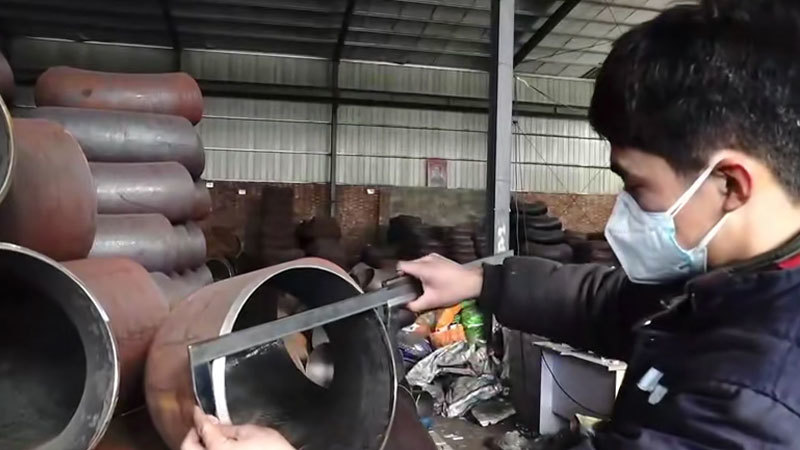
A: You can check its surface smoothness, mark completeness, measure actual wall thickness and nominal diameter, and require manufacturer to provide official material test report for verification.
Q: Can pipe elbow be used for high temperature steam transmission system?
A: Yes, you can select alloy steel or high-grade carbon steel pipe elbow with corresponding pressure rating, which can work stably under 550℃ high temperature steam environment.
Q: What is the difference between pressed elbow and forged pipe elbow?
A: Pressed elbow is suitable for general low and medium pressure scenarios, while forged elbow has denser inner structure, which is more fit for ultra high pressure critical pipeline applications.
This article was generated by AI and is for reference only.
TAG:
Related Posts

April 15, 2025 Wednesday Guangzhou · Pazhou Complex


MESSAGES
We will contact you within one working day. Please pay attention to your email.

CEO : Leo Liu
International Dep: Lisa Sun