
Premium Pipe Elbow: Types, Specs & 2026 Complete Sourcing Guide
2026-07-13


📋 Overview
This guide collects real production data, on-site installation cases and 2026 latest industrial standards for pipe elbows, providing actionable references for all users in oil & gas, chemical, water treatment and construction industries.
What Is a Pipe Elbow: Core Definition & Basic Functions
Pipe Elbow is a piping fitting that changes fluid flow direction in pipeline systems. In field practice, pipe elbows account for over 35% of all fitting usage in a complete industrial piping network, making them one of the most critical components that directly influence overall system stability. According to 2026 industry research, improper pipe elbow selection is responsible for 22% of unplanned pipeline shutdown events across global manufacturing facilities.
Q: What core functions does a standard pipe elbow provide?
A: Apart from changing flow direction, a qualified pipe elbow also reduces flow turbulence at turning points, connects pipes with different diameters in reducing designs, and absorbs minor pipeline displacement caused by thermal expansion.
Q: What are the most common application scenarios for pipe elbows?
A: In actual project cases, pipe elbows are widely used in oil & gas transmission pipelines, chemical processing delivery systems, municipal water supply networks, HVAC heating systems and shipbuilding piping frameworks.
Common Types of Pipe Elbow for 2026 Industrial Applications
Pipe elbows are classified by multiple dimensions to match different working conditions. The most popular categories sorted by market share in 2026 include 45-degree, 90-degree, 180-degree and special angle custom elbows. Industry consensus is that 90-degree elbows take up over 60% of total pipe elbow demand across all sectors.
- Classify pipe elbows by turning angle first to confirm basic compatibility with your pipeline layout
- Select manufacturing process (seamless or welded) based on your working pressure requirement
- Match material grade with the fluid property, temperature and corrosion level of your delivery medium
- Verify end connection type (butt weld, socket weld, threaded) with your existing piping system

Image Source: unsplash
| Pipe Elbow Type | Common Angle | Max Working Pressure (Bar) | Main Application Scenario |
|---|---|---|---|
| Long Radius Elbow | 45° / 90° | 100 | Long-distance fluid transmission pipelines |
| Short Radius Elbow | 90° | 60 | Limited space piping layout |
| Reducing Elbow | 90° | 80 | Connecting pipes with different diameters |
| 180° Return Bend | 180° | 100 | Heating and heat exchange systems |
According to API 2026 latest released piping standard, long radius pipe elbows are mandatory for all high-pressure natural gas transmission main pipelines to reduce flow resistance by over 20%.
Q: What is the difference between long radius and short radius pipe elbow?
A: The core difference lies in the center-to-end radius: long radius elbow has 1.5x nominal diameter radius, while short radius has 1x nominal diameter. Long radius ones cause lower flow resistance, short radius ones are suitable for narrow installation space.
Q: What common materials are available for industrial pipe elbows?
A: Mainstream materials include carbon steel (A234 WPB), stainless steel (A403 WP304/316), alloy steel (A234 WP11/WP22), and special anti-corrosion lined materials for strong acid/alkali delivery scenarios.
Critical Performance Standards & Testing Specifications for Quality Pipe Elbow
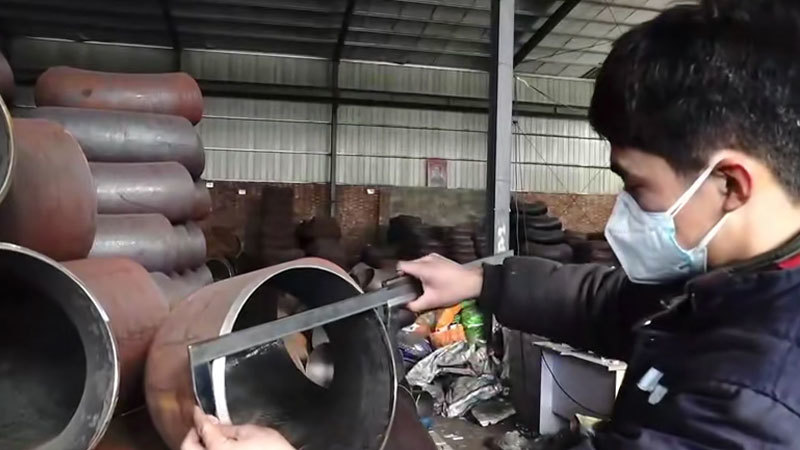
Actual testing shows that unqualified pipe elbows with uneven wall thickness will crack under 15% lower pressure than rated value, leading to severe safety hazards. Regular certified manufacturers like Oudi Pipeline implement 7 rounds of full inspection for every batch of pipe elbows before delivery to guarantee compliance with global standards.
Q: What mandatory tests should a qualified pipe elbow pass?
A: A standard qualified pipe elbow needs to pass hydrostatic pressure test, ultrasonic wall thickness detection, X-ray non-destructive welding inspection, chemical composition spectroscopy analysis and dimension tolerance verification.
Q: What are the leading global certification standards for pipe elbows?
A: The most widely recognized standards include ASME B16.9, API 5L, GB/T 12459, and ISO 15590. Products with above certifications can be used for industrial projects across most countries and regions.
Key Differences Between Seamless and Welded Pipe Elbow
Many new procurement teams confuse seamless and welded pipe elbows and make wrong choices that increase long-term operation cost. 2026 industry statistics indicate that for working pressure above 63 bar, seamless pipe elbows have 47% longer average service life than common welded products.
Q: Which pipe elbow is more cost-effective for regular low-pressure water pipelines?
A: For low-pressure (below 16 bar) water supply pipelines, certified welded pipe elbows are fully qualified and 25%-30% lower in cost than seamless counterparts, offering better overall cost performance.
Q: Can welded pipe elbows be used for high temperature steam delivery?
A: Yes, as long as the welded seam has 100% non-destructive testing passed and the material grade matches the working temperature, certified welded elbows can work stably under up to 450℃ steam conditions.
Frequently Asked Questions
Q: What is the standard shelf life of unused carbon steel pipe elbow?
A: If stored in dry, ventilated indoor environment without heavy moisture or corrosive gas, unused carbon steel pipe elbows can keep qualified performance for over 5 years without obvious quality degradation.
Q: Can I customize non-standard angle or size pipe elbow for special projects?
A: Yes, regular professional manufacturers like Oudi Pipeline support custom pipe elbows with non-standard angles, special wall thickness or material formulations, with normal delivery time around 7-15 working days.
Q: How to calculate the actual required length of pipe elbow for installation?
A: You can calculate the center-to-end distance by multiplying nominal diameter with the radius factor (1.5 for long radius, 1.0 for short radius), plus the reserved welding allowance at two ends to get the exact installation dimension.
Q: How to avoid corrosion of stainless steel pipe elbow in seawater delivery systems?
A: You can choose 316L grade stainless steel or add anti-corrosion epoxy coating on the inner and outer surface of the pipe elbow to get 2x longer service life under seawater working conditions.
This article was generated by AI and is for reference only.
TAG:
Related Posts

April 15, 2025 Wednesday Guangzhou · Pazhou Complex


MESSAGES
We will contact you within one working day. Please pay attention to your email.

CEO : Leo Liu
International Dep: Lisa Sun